



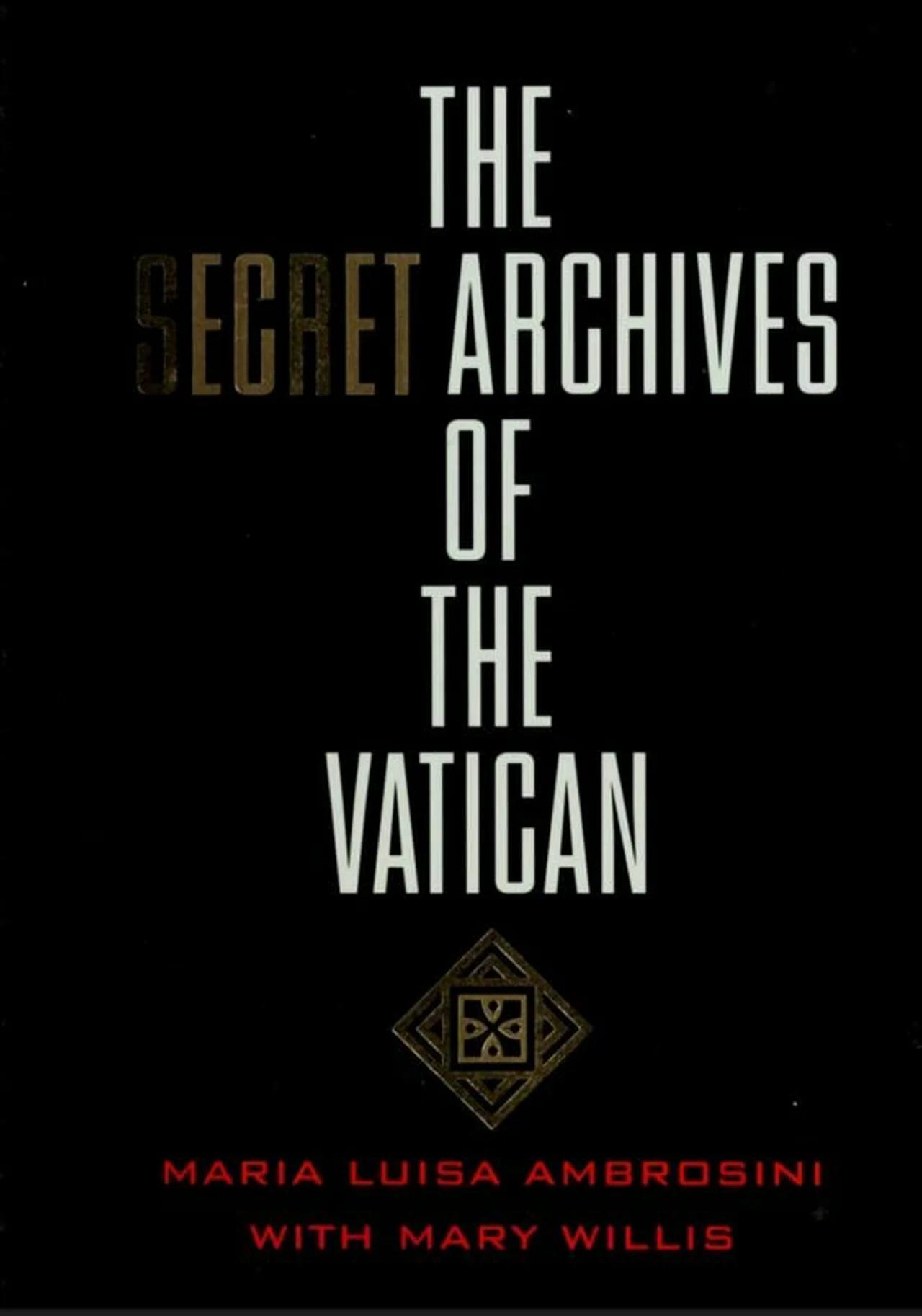
The Secret Archives of the Vatican (Maria Luisa Ambrosini; 1996)
Overview
Maria Luisa Ambrosini’s "The Secret Archives of the Vatican" provides an intimate and captivating tour of one of the world's most vast and mysterious historical repositories. The text chronicles how a modest collection of early Christian documents evolved into twenty-five miles of shelved papers, tracking the parallel history of the papacy and the broader world. Through a blend of personal discovery and historical inquiry, the author reveals that these archives function not merely as dead tombs of the past, but as a dark mirror of human civilization. Ultimately, the book serves to illuminate both the administrative heart of the Catholic Church and the fragile, enduring fragments of human history preserved within its walls.
Download
Archival Methods Guide: Navigating Historical Repositories through the Lens of the Vatican Archives
1. Introduction: Demystifying the Repository
1.1 What is an Archive?
An archive is not a static "tomb of the past," but a dynamic, functioning organ of administrative record-keeping. Rather than serving as dusty mausoleums for forgotten ideas, archives originate as active, working files created by institutions, courts, and administrative bodies to conduct daily business. Over time, as administrative documents age, they naturally transition out of immediate utility and enter the realm of historical evidence. An archive thus reflects the living operations of the entity that created it, preserving functional correspondence, petitions, legal rulings, and financial transactions that eventually serve as a window into human history.
1.2 Fundamental Differences: Archives vs. Libraries
To navigate historical records effectively, researchers must distinguish between a library and an archive. While both store valuable knowledge, their core materials, originating purpose, structural organization, and access rules differ fundamentally.
Comparison: Libraries vs. Archives
| Feature | Library (e.g., Vatican Library) | Archive (e.g., Vatican Secret Archives) |
|---|---|---|
| Primary Contents | Individual published or manuscript works, books, and collections organized primarily around subject matters such as theology, philosophy, and art history. | Interdependent working files, administrative dispatches, official registers, diplomatic correspondence, court records, and financial receipts. |
| Primary Function | Educational and subject-based collection designed for broad intellectual study, reference, and literary consultation. | Functional administrative utility for a governing body (e.g., the papal Curia) that gradually ages into historical evidence. |
| Access Strategy | Open browsing or subject/author search systems utilizing card catalogues, digitized author indexes, and thematic call numbers. | Strict permission screening on a "need-to-know" basis, closed stacks with no direct browsing, and retrieval based strictly on original institutional provenance. |
Understanding this dynamic administrative nature of archives requires mastering a unique set of historical terminology and organizational concepts that dictate how materials are categorized and retrieved.
2. Core Archival Terminology and System Architecture
2.1 Essential Archival Vocabulary
- Scrinium (or Chartarium): Derived from the ancient Roman term for a screened repository set apart from public access, the Scrinium (such as the Scrinium Sanctae Romanae Ecclesiae) or Chartarium refers to the official office or safe repository used to store and protect an institution's administrative, legal, and financial records. Historically constructed using specialized wood (lignum scrinarium), it functioned as the core administrative filing center for council acts, official decrees, and property deeds.
- Fondo (pl. Fondi): A discrete, organic major collection or grouping of records deposited by a specific originating body, department, or family (e.g., the Borghese family archives, court records, or diplomatic nunciatures). Repositories divide these into closed fondi (completed, static historical acquisitions to which no new records are added, such as the Miscellanea) and live fondi (active repositories continually receiving unclassified incoming items or unassigned loose manuscripts, such as the Instrumenta Miscellanea).
- Buste: Individual folders, bundles, or packages holding loose, unbound documents. These are frequently filed chronologically or by year and often contain hundreds of un-inventoried individual sheets awaiting historical cataloguing.
- Armadi: Wooden storage cabinets, closets, or cupboards specifically built to house manuscript volumes, historical series, and bound registers (such as the poplar wood armadi commissioned in the 17th century under Pope Paul V Borghese).
- Registers: Bound, handwritten chronological books containing duplicate official copies (the historical equivalent of carbon copies) of outgoing correspondence, decisions, and papal bulls produced by chancellery officials.
- Polyptycha / Formats: Structural physical forms used for historical documentation before the widespread adoption of modern bound books. This includes polyptycha (bound wooden or parchment writing tablets used for early administrative lists) and long scroll formats (such as 13-foot purple parchment scrolls recorded in gold ink).
2.2 Specialized Administrative Forms
- Avvisi: Insight into early news gathering and diplomatic intelligence. These were early information dispatches and news bulletins (resembling early newspapers) appended as loose sheets (foglio di avvisi) to formal diplomatic reports sent by nuncio offices. Containing court gossip, agent dispatches, and commercial news gathered from sailors and merchants across major European cities, they reveal the informal communication channels of early modern Europe.
- Liber Diurnus: Insight into standardized daily Chancellery operations. Written on parchment in a clear Lombard script, this daily Chancellery formula book contains exactly 117 standardized text models used by notaries to draft official administrative acts, property exchanges, monastic slave transfers, and church consecrations. These sample formulas provide concrete details regarding everyday medieval hospital management and administrative bureaucracy.
- Liber Pontificalis: Insight into institutional biography and narrative record-keeping. A compiled "Book of the Popes" containing sequential biographical entries from Saint Peter onward. Used as an institutional reference compendium, it details early church construction, charitable deaconates, recorded papal gifts, and references to early lost archives.
Armed with this foundational archival vocabulary, a researcher can better understand how these structural units map directly onto the physical geography and organizational design of a major historical repository.
3. Collection Organization and Physical Structure
3.1 The Principle of Provenance (Originating Offices)
Unlike libraries, which group books by subject matter, archives are organized strictly according to the Principle of Provenance. Records naturally accumulate through the daily operational function of specific departments, courts, and administrative offices (such as the Consistory, the Sacred Rota, the Chancellery, or diplomatic Nunciatures). Because an archive is an interdependent record of institutional activity, documents cannot be rearranged by topic without destroying their context. Reorganizing administrative records by subject breaks the organic operational context and sequence of the department that created them, rendering the institutional logic invisible.
The Golden Rule of Provenance: Archives are not compiled by subject; they are generated by function. To locate any historical document, a researcher must first identify the exact institutional office, tribunal, or department that created or received it in the course of its daily operations. Attempting to re-index or group archival documents by topic destroys the organic administrative context that gives the records their historical validity.
3.2 Physical Mapping of a Major Repository: Case Study of the Vatican Archives
The physical layout of a major repository mirrors its historical expansion across space and time:
- Ground-Floor Corridors: A modern, windowless subterranean zone equipped with two-level steel shelving holding modern functional series (e.g., Consistory records on cardinal deliberations, conclave vote tallies, petitions, and Sacred Rota court records). This area also houses locked security safes and vaults containing ultra-precious relics (e.g., two-pound royal gold seals, Queen Christina’s abdication document, Mary Stuart’s final letter, and trial confessions).
- Tower of the Winds & Upper Floor Cabinets: The historical core established in 1612 by Paul V Borghese. It features 17th-century poplar wood armadi containing nearly 5,000 papal registers, alongside the Archivum Arcis (the protected fortress archives originally stored in Castel Sant'Angelo to survive military sacks).
- Hall of the Parchments: A dedicated room containing thousands of foundational documents establishing legal rights and territorial holdings. This sector faces delicate biological preservation challenges, such as the destructive violet fungus affecting historical materials.
- Attic Corridors & Meridian Room: Spatial extensions running along upper architectural walls that house diplomatic nunciature correspondence, 150 volumes of avvisi, and thousands of un-inventoried manuscript packages (buste). At the top sits the Meridian Room, an early astronomical observatory featuring a floor zodiac used to calculate the Gregorian calendar.
- Riserva: A closed, restricted repository holding extraordinarily valuable collections (such as the original trial transcripts of Galileo and high-stakes treaties) accessible only through special permission from the prefect.
Tracing these physical spaces and institutional divisions provides the spatial framework necessary to execute a practical primary research strategy.
4. Primary Research Methodology: Finding and Extracting Sources
4.1 Step 1: Institutional Context and Prerequisite Knowledge
- Identify the Target Originating Body: Because keyword searches do not exist in archival research, you must first research the administrative structure of the historical era to identify the exact department, court, or office that handled your subject matter.
- Determine Administrative Function and Relationships: Establish how your subject interacted with the institution. Did the individual file a petition, undergo a trial in an ecclesiastical court (Sacred Rota), receive a consistorial benefice, or correspond with an ambassador (nuncio)?
- Select the Corresponding Fondo: Match the administrative function to a specific archival collection (fondo) before consulting staff, who require researchers to know which fondo to request.
4.2 Step 2: Navigating Legacy Inventories and Indexes
Finding aids in major historical repositories rarely resemble modern electronic databases. Researchers must navigate legacy systems with specific limitations:
Key Takeaways: Legacy Finding Aids
- Handwritten Volumes over Digital Systems: Finding aids consist of hundreds of massive, handwritten legacy volumes (e.g., Cardinal Garampi’s 684-volume index) rather than digital databases.
- Complex Symbols and Abbreviations: Legacy indexes rely heavily on specialized symbols, historical abbreviations, and inconsistent scripts (such as Garampi's variable Greek letter notation) that require specialized handbooks to decode.
- Incompleteness and Un-inventoried Buste: The absence of a subject from an index does not prove it is missing from the repository; vast numbers of loose document packages (buste) remain completely un-inventoried. For example, a single bookcase opening off the Meridian Room contains 9,000 un-catalogued packages (buste); simply inventorying them chronologically would take two experts 180 years of continuous labor.
4.3 Step 3: Executing a Cross-Fondo Investigation
Because historical events touch multiple institutional arms, researchers must piecemeal evidence across disparate fondi. Consider a hypothetical investigation into the Trial of the Knights Templar:
- Papal Registers: Search the bound registers of Pope Clement V to locate official papal decrees, bulls, and outgoing administrative correspondence regarding the order.
- Council Records: Consult scattered administrative and judicial records from the Council of Vienne, where the formal dissolution of the Templars was deliberated.
- Miscellanea & Instrumenta Miscellanea: Search both closed and live grab-bag collections for loose summaries, secret papal dispatches, 14th-century inquisitorial report summaries, and financial banking tracks.
- Archivum Arcis: Search the fortress archives transferred from Castel Sant'Angelo for high-security state trial records, ancient inventories, and imperial diplomas.
- Related Sovereign Fondi: Examine collections associated with external political actors—such as dispatches related to King Philip the Fair of France—to capture diplomatic context and external political pressure.
Mastering these rigorous, cross-collection retrieval techniques transforms primary research from an overwhelming search for dusty records into an artful, deliberate intellectual investigation.
5. Conclusion: Synthesis and the Learner’s Mindset
5.1 Essential Takeaways for Aspiring Historians
- Context Over Catalogues: True primary research requires a deep understanding of institutional history. Knowing how an administrative body functioned in the past is the absolute prerequisite to finding any individual document today.
- Patience with Legacy Systems: Archival finding aids are historical artifacts themselves. They reflect the biases, abbreviations, and cataloguing systems of the eras in which they were compiled, requiring high frustration tolerance and methodical decoding.
- The Thrill of Discovery: Because vast sectors of major repositories remain unexplored or un-inventoried (illustrated by the single bookcase of 9,000 buste that would require 180 expert-years to catalog), archival research is an active intellectual hunt. Within these stacks, static papers transform into living human experience, offering the endless possibility of original discovery.
The Survival and Evolution of Papal Records: A Beginner’s Historical Guide
1. Introduction: The Archives as the "Dark Mirror" of History
For centuries, the repositories hidden behind the high walls of Vatican City have captured the popular imagination. Far from being a mere dusty warehouse of forgotten parchment, the record-keeping system of the papacy functions as a living chronicle of human civilization. Historical scholars frequently describe the collection as a reflecting glass of Western history:
"The history of the Secret Archives was the history of the papacy, of the Church; ... the Archives were a dark mirror of the world."
To understand this institution, a student must first master a fundamental distinction between the two twin—and occasionally rival—intellectual centers of the Holy See:
- The Vatican Library: A repository primarily dedicated to individual literary, artistic, and philosophical works, manuscripts, and codices gathered for scholarly study, intellectual enrichment, and display.
- The Secret Archives (L'Archivio Segreto Vaticano): The functional, working administrative and diplomatic files of the papal Curia. It contains active governance records, register copies of official correspondence (bulls and epistles), legal petitions, trial transcripts, and state records generated by the Church's daily administration.
The story of how these records survived from antiquity to the modern era embodies the classic legend of Sisyphus. Papal archival history represents a perpetual, exhausting cycle where administrators roll the heavy stone of institutional memory up the hill through painstaking creation, only to watch it crushed down by catastrophic fires, barbarian sacks, feudal feuds, and foreign confiscations. The continuous historical record available to scholars today is not the result of peaceful, uninterrupted preservation, but the product of centuries of fierce administrative determination to repeatedly roll the stone back up the hill through secondary copying, compilations, and structural re-centralization.
To trace this Sisyphean labor back to its origin, one must look past the grand marble basilicas of modern Rome to the obscure, hidden world of the city's early underground Christian communities.
2. Era I: The Underground Church & Catacomb Records (1st–3rd Centuries)
During the first three centuries of the Common Era, Christianity existed as an illegal, periodically persecuted sect within the Roman Empire. The earliest papal records were not housed in monumental palaces, but were decentralized throughout the working-class districts of Rome. Record keepers operated primarily in Trastevere—the crowded quarter across the Tiber River inhabited by the Jewish Diaspora and laboring communities—and inside early house-churches known as Domus Ecclesiae (such as the ancient structural layers preserved beneath Saint Clement's Church).
Despite operating underground, the early Church developed a formal administrative framework. Record-keeping was systematically organized under Pope Fabian (236–250 AD), who commissioned seven notaries to collect martyrs' trial accounts (acta martyrum). The primary administrative records maintained during this period were created to serve immediate practical needs:
- Membership Rosters and Baptismal Rolls: Maintained to track the rapidly growing community of believers and verify the standing of initiates.
- Relief Distribution Registers: Created under the Church's deaconate system to organize daily charity, food distribution, and shelter for impoverished members, widows, and orphans.
- Financial Receipts and Property Records: Formulated to track donations, burial plot acquisitions in the subterranean catacombs, and warehouse inventory supplies such as oil and grain.
- Martyrdom Trial Transcripts: Judicial reports gathered by official notaries to preserve community identity and spiritual heritage.
St. Peter and St. Paul
Representing the apostolic foundation of Christian record-keeping, their foundational epistles formed the earliest core of Church communication. Paul dictated key letters (such as his epistle to the Romans) to secretaries like Luke, while Peter utilized Mark and Sylvanus to write and deliver early papal encyclicals "from Babylon" (Rome) to distant communities in Asia Minor. When Imperial persecutions struck, early Christians began their first Sisyphean recovery efforts by sending duplicate transcriptions of these texts to provincial churches across the Mediterranean, ensuring their survival even if the originals in Rome perished.
St. Lawrence the Librarian
During the intense Valerian persecutions of 258 AD, Imperial authorities targeted the Church’s administrative infrastructure. Imperial police sought membership lists and financial records to dismantle the deaconate relief system and seize Church wealth. Entrusted with the Church’s records and treasury, Lawrence decentralized and hid the administrative files while distributing the gold and silver to the poor. Subjected to fatal torture on a gridiron, Lawrence died without surrendering the location of the records or the identity of community members. His physical martyrdom remains embedded in archival memory: annually on August 10 at the Vatican, Lawrence's head is exposed in a golden reliquary, displaying his burned skull bone and mouth distorted from the gridiron torture.
Early Christians adapted to Imperial pressure by hiding rolls in subterranean catacombs and dispatching secondary duplicate copies to foreign churches.
This chaotic, hidden period of catacomb record-keeping came to an abrupt end in the fourth century, when imperial hostility unexpectedly transformed into royal sponsorship.
3. Era II: Imperial Recognition, the Holy Scrinium, and the Vulgate (4th Century)
The ascension of Emperor Constantine dramatically reshaped Christian record-keeping. Through imperial patronage, the Church transitioned from subterranean house-churches to grand public basilicas. The official papal residence established at the Lateran Palace (the Episcopium Lateranense) became the administrative heart of the papacy for nearly a millennium, while the grand Basilica of Saint Peter was constructed over the Apostle’s tomb on Vatican Hill.
During this era, the papacy formalized its record repository into the Holy Scrinium (Scrinium Sanctae Romanae Ecclesiae) or Chartarium, located near the present Apostolic Chancellery at San Lorenzo in Damaso. This central office adapted Roman civil service methods, employing a structured corps of notaries (scrinarii) headed by a primicerius to draft, register, and archive all Church legal acts, council decisions, and property deeds.
This transition to institutional stability followed the most catastrophic crash of the Sisyphean stone in antiquity: the Diocletianic Persecution (303–305 AD). Emperor Diocletian ordered the systematic public burning of Christian scriptures, legal records, and administrative documents in town squares throughout the Empire, causing near-total loss of the Church's early central physical archives.
| Criterion | Imperial Persecution (Diocletian Era) | Imperial Institutionalization (Constantine/Damasus Era) |
|---|---|---|
| Physical Location | Secret house-churches (Domus Ecclesiae), catacombs, private residences. | Grand public basilicas (Lateran Palace) and dedicated archival centers (Holy Scrinium / Chartarium). |
| Main Threat | Systematic Imperial seizure, public bonfires of scriptures/records, execution of record custodians (traditores). | Structural wear, fires, and textual corruption from repeated manual copying. |
| Record Security | Decentralization, secret transport of copies to provincial cities, custodial silence under torture. | Imperial legal protection, standardized civil service registration by professional notaries (scrinarii), dedicated archival porticos. |
Pope Damasus
Raised in the house of the archives (his father having been an archival employee and priest), Damasus was a scholar, poet, and administrator. He restored and expanded the Chartarium building at San Lorenzo in Damaso, protecting master records through physical reconstruction. His architectural work is immortalized in his own inscribed verses:
"I have built new roofs for the archives, And added columns at the left and right That the name of Damasus may live through the centuries."
Damasus also designed elegant calligraphic letterforms for official acts and papal inscriptions, institutionalizing official document production.
St. Jerome
Serving as papal secretary to Pope Damasus, Jerome utilized the master texts stored in the Holy Scrinium and Roman Christian libraries to revise and translate the Bible into Latin—producing the Vulgate. Working alongside a circle of highly educated patrician women in his "House of Ladies" on the Aventine Hill (including the noblewoman Paula), Jerome established rigorous textual scholarship, comparing Greek and Hebrew manuscripts to correct centuries of scribal error.
The relative structural security established in the fourth century was soon shattered, however, as the collapse of the Western Roman Empire ushered in catastrophic waves of barbarian invasions that threatened the very survival of Western literacy.
4. Era III: Barbarian Invasions, Compilations, and Monastic Lifelines (5th–8th Centuries)
Between the fifth and eighth centuries, successive waves of destruction rolled the archival stone back down the hill. Sacking of Rome by Alaric’s Goths in 410 AD (which burned large portions of the Lateran area), Genseric’s Vandals in 455 AD, and subsequent Lombard and Saracen incursions resulted in the widespread loss of original papyrus rolls and early codices.
To roll institutional memory back up the hill, the papal Chancellery began compiling condensed administrative, legal, and historical digests. These compilations preserved core operational knowledge even when primary documents perished:
| Compilation Name | Primary Purpose | Historical Significance |
|---|---|---|
| Liber Canonum / Liber Decretorum | A systematic collection of Eastern synod acts and papal legal decrees compiled by Dionysius Exiguus. | Extended by Pope Adrian I as the Collectio Dionysio-Hadriana, it was adopted by Charlemagne and served for centuries as fundamental canon law across Western Europe. |
| Liber Pontificalis | A chronological series of detailed papal biographies beginning with St. Peter. | Synthesized early administrative notes, building records, major donations, and archival inventories into an enduring narrative history of the papacy. |
| Liber Diurnus | A Chancellery formula book containing 117 standardized text models for drafting papal acts, letters, and decrees. | Provided uniform legal language for Church administration; preserved records of daily operations, including checklists for hospital beds, thermal baths, and slave manumission protocols. |
Monastic Lifelines: Preserving Written Culture
As central civic structures collapsed, monastic networks emerged as the vital infrastructure for preserving Western literacy and copying damaged texts:
- St. Benedict of Nursia (480–543 AD): Authored the Benedictine Rule, establishing self-sufficient monastic communities that balanced prayer, manual labor, and compulsory daily reading. This mandate made scriptoria (copying rooms) and libraries essential to every monastery.
- Cassiodorus (490–585 AD): A former imperial minister who founded the monastery of Vivarium in southern Italy. He established professional copyist standards and integrated classical pagan literature, history, and science (trivium and quadrivium) into Christian education, ensuring the survival of secular antiquity alongside theology.
- Irish Monasteries: Operating outside the collapsed borders of the Roman Empire, Irish monastic centers preserved knowledge of Greek and classical Latin. Irish scribes produced intricate illuminated codices and carried written culture back to continental Europe through missionary networks.
- Pope Gregory the Great (590–604 AD): A master administrator who organized papal land holdings to feed refugees during the Lombard wars. He maintained a 14-roll papyrus register of official correspondence, systematically organized liturgical music (the Gregorian Chant / Schola Cantorum), and maintained extensive missionary correspondence. Physical evidence of his Chancellery output survives in the cathedral treasury at Monza: the original papyrus labels (pittacia) attached to oil ampoules sent by Gregory to Queen Theodolinda, representing the only direct physical fragments of his administrative dispatches that survived material decay.
This network of monastic preservation laid the intellectual foundation for a grand political renewal under the Carolingian Empire.
5. Era IV: Feudal Chaos, Imperial Struggles, and Centralization (9th–17th Centuries)
The coronation of Charlemagne as Holy Roman Emperor on Christmas Day, 800 AD, initiated a period of political alignment and administrative reform, though feudal instability would repeatedly threaten archival integrity.
- 800 AD – The Carolingian Renaissance and Script Reform: Charlemagne and his chief scholar, Alcuin of York, standardized European writing by introducing Carolingian minuscule—a clear, highly legible script that greatly increased copying speed and accuracy. Charlemagne ordered the creation of the Codex Carolinus to archive all papal dispatches and deposited imperial donations directly at Saint Peter's tomb (The Confession).
- 900s–1000s AD – Feudal Fragmentation and Record Loss: Following the breakdown of the Carolingian Empire, Rome fell into severe political factionalism. During the era of the "iron popes," rival noble families (such as Theophylact, Marozia, and Theodora) controlled papal appointments. Opposing political factions regularly looted archives, erased codices, or destroyed legal registers—such as the records of the "Cadaver Synod," in which the exhumed corpse of Pope Formosus was placed on trial. Despite these losses, vital registers survived through secondary monastic copying. A primary example is John VIII's correspondence preserved in Vatican Register 1 (Reg. Vat. 1). This volume is an 11th-century copy in Beneventan script produced at Monte Cassino; bound in red leather, it contains draft Chancellery copies with blank spaces left where the copyist could not decipher damaged original text. Similar survival mechanisms preserved Gregory VII's reform decrees (Dictatus Papae, 1075 AD).
- 1100s AD – The Turris Chartularia (Tower of the Papers): Seeking safety from urban warfare, the papacy relocated its primary archives to a fortified stone tower on the Palatine Hill near the Arch of Titus, known as the "Tower of the Seven Lamps" (Turris Chartularia). Guarded by the allied Frangipani family, it served as the primary secure repository (locus tutissimus). However, as Rome erupted into repeated feuds between families like the Frangipani, Orsini, and Colonna, the tower was repeatedly besieged, resulting in catastrophic loss of pre-12th-century original rolls.
- 1198–1216 AD – Innocent III and Administrative Continuity: Pope Innocent III established the unbroken, continuous series of papal registers that survives to this day. Recognizing the insecurity of the Palatine, Innocent began shifting administrative offices toward Vatican Hill and enforced strict Chancellery registration for every outgoing and incoming document.
- 1612 AD – Formal Centralization under Pope Paul V: Pope Paul V (Borghese) officially established the Archivio Segreto Vaticano. He centralized all surviving Curial records into a permanent, dedicated wing adjacent to the Vatican Library, fitting them with protective poplar cabinets that remain in use today.
- 1810 AD – The Napoleonic Looting: The Sisyphean cycle experienced a major modern crash when Napoleon Bonaparte ordered the transport of the central archives to Paris to construct a universal world library. Following Napoleon's defeat, over 2,000 registers were lost during the return journey, with thousands of priceless parchment sheets sold as wastepaper to Parisian grocery stores and drugstores to wrap parcels before the remaining volumes were restored to the Vatican.
With the establishing of centralized repositories, the historical struggle shifted from physical relocation to an ongoing interplay between systematic destruction and institutional survival mechanisms.
6. Analytical Synthesis: Threats to Survival vs. Preservation Counter-Mechanisms
The survival of early papal records was not a passive occurrence, but an ongoing conflict between forces of destruction and human mechanisms of preservation.
| Category of Threat | Historical Examples & Specific Lost Records | Preservation Counter-Mechanism |
|---|---|---|
| Imperial Persecution | Diocletian’s public bonfires (303 AD) burning sacred texts, early membership rolls, and administrative registers in public squares. | Decentralization & Secret Copying: Dispatching duplicate copies to provincial bishops (e.g., in Gaul and North Africa) and hiding records in subterranean catacombs. |
| Barbarian Invasions & Fires | Sack of Rome by Alaric's Goths (410 AD) burning the Lateran; Vandal looting (455 AD); Saracen raids damaging basilicas. | Monastic Scriptoria & Compilations: Continuous manual copying in Benedictine and Irish monasteries; creation of condensed digests (Liber Pontificalis, Liber Diurnus). |
| Political Feuds & Warfare | Destruction of the Turris Chartularia; theft/erasure of rival registers during the 10th-century "iron popes" era; Napoleonic transport losing 2,000 registers to Parisian wastepaper trade. | Fortified Repositories & Relocation: Moving archives to fortified stone towers (Turris Chartularia), Castel Sant'Angelo (Archivum Arcis), and eventually Vatican Hill for Paul V's 1612 centralization. |
| Material Decay & Inefficiency | Organic rot of fragile early papyrus rolls; ink decay; violet fungus damaging parchment (Hall of Parchments). | Durable Media & Calligraphic Reform: Transitioning from papyrus rolls to durable parchment codices; adopting clear scripts (Carolingian minuscule) and standardized formulas (Liber Diurnus). |
This analytical breakdown underscores the broader historical principles that every aspiring student of history must internalize.
7. Conclusion: Core Takeaways for the Aspiring Historian
The history of early papal records provides essential insights for any student entering the study of history:
- History is inherently fragmentary: What remains in an archive today is rarely a complete picture. Historical narrative is assembled from what survived through fortunate chance, monastic labor, or secondary copying following repeated Sisyphean destructions, rather than uninterrupted preservation.
- Administrative necessity drives document survival: While sacred texts were revered, practical legal and administrative needs—such as property deeds, tax inventories, hospital checklists, and standardized Chancellery formulas (Liber Diurnus)—were the primary drivers that rescued civilization's intellectual memory when purely literary works perished.
- The Vatican Archives are a living, functioning repository: Far from being a static museum of dead history, the Secret Archives remain an active working organ of Church governance, continuously bridging ancient antiquity to the modern world through twenty-five miles of dynamic historical documentation.
The Ink of Empire and Altar: Papal Statecraft, Diplomatic Registers, and Archival Epistemology Across the Centuries
1. Administrative Foundations of Papal Diplomacy and Archival Architecture
The administrative documentation of the Roman Catholic Church stands as a monumental apparatus of global governance, wherein routine working files evolved over a millennium into the primary instruments of international statecraft and historical record-keeping. What began as fragile, utilitarian instruments designed for institutional survival amidst political volatility gradually transformed into an authoritative diplomatic record. The working files of the papal Curia—conceived to regulate internal ecclesiastical discipline, log property titles, and issue executive mandates—expanded into a comprehensive repository of international law. Through the systematic registration of outgoing letters, the preservation of sovereign petitions, and the institutionalization of diplomatic correspondence, papal administrative writing became a central pivot around which European and transcontinental geopolitics revolved, converting functional administrative memory into the ultimate benchmark of legal legitimacy and historical truth.
The physical and organizational evolution of this institutional memory traces a trajectory from early vulnerability to centralized statecraft. In the early Church, record-keeping was decentralized and precarious. The ancient repository, known variously as the Scrinium or Chartarium (Scrinium Sanctae Romanae Ecclesiae), functioned as a combined library and working archive. It was fiercely guarded by administrative personnel such as Saint Lawrence the Librarian, who suffered martyrdom during the Valerian persecutions of 257–258 after distributing the Church's financial assets to the poor and concealing its administrative rosters to protect the community from imperial confiscation. Following the legalization of Christianity, Pope Damasus I (366–384) significantly elevated the institutional status of the archives. Having grown up among the codices as the son of an archives employee, Damasus expanded the physical architecture of the repository—erecting new roofs and colonnades at its site near the present-day Apostolic Chancellery—and sponsored Saint Jerome as his papal secretary. Jerome utilized the Chartarium to systematically edit, revise, and translate the Latin Vulgate, drawing upon master manuscript copies and comparative texts preserved within the papal collections. Despite repeated fires, sacks, and forced relocations across centuries, this administrative apparatus gradually coalesced into a centralized repository. The pivotal transformation occurred in 1612, when Pope Paul V (Borghese) officially established the centralized Vatican Secret Archives (L'Archivio Segreto Vaticano). Paul V ordered that disparate collections scattered across the Vatican, the Lateran, and Castel Sant'Angelo be gathered into a unified facility adjacent to the Vatican Library, permanently converting volatile working files into an enduring archive of global statecraft.
At the core of this administrative enterprise lay precise procedural mechanisms designed to standardize papal statecraft. The Liber Diurnus (or "Daily Book"), compiled before the ninth century and preserved on parchment in a Lombard script, served as the primary Chancellery formula book. Containing 117 standardized procedural models, it governed the drafting of papal acts, official messages, hospital inventory classifications, slave manumissions, and church dedication prayers, ensuring administrative continuity across pontificates. Complementing these standardized formulas was the development of specialized scribal scripts and systematic registration. Within the papal Chancellery, notary hands evolved from the ancient curiale romana to the more rounded curiale nova, and ultimately to the refined, cursive minuscula cancellaresca. This calligraphic evolution was not merely aesthetic; it served a vital paleographic and diplomatic function, establishing stringent authentication standards to prevent forgery and maintain administrative uniformities across international dispatches.
These Chancellery hands were deployed systematically in the compilation of the Vatican Registers, which constituted the main chronological record of outgoing papal statecraft. Though earlier stray volumes exist—such as the register copy of John VIII in the ninth century and Gregory VII in the eleventh century—the regular, unbroken flow of the Vatican Registers began systematically in 1198 under Pope Innocent III. Compiled by notaries and scrinarii within the Chancellery, these bound parchment volumes contained carbon-like draft copies of official papal letters, bulls, and administrative decrees. Running to 4,857 volumes, the registers functioned as an authoritative legal and diplomatic ledger, enabling the Holy See to project its judicial, administrative, and geopolitical authority across Christendom.
| Fondo Name | Primary Contents / Document Types | Diplomatic & Administrative Function | Historical Significance to International Statecraft |
|---|---|---|---|
| Vatican Registers (Registra Vaticana) | 4,857 oversized parchment volumes containing handwritten draft copies of outgoing papal letters, bulls, mandates, and internal incoming letters. | Serves as the primary executive ledger of outgoing papal correspondence, judicial rulings, and administrative commands. | Establishes unbroken documentation of medieval and early modern papal diplomacy, legal precedents, and territorial governance starting systematically in 1198. |
| Archivum Arcis (Archive of Castel Sant'Angelo) | The Trésor de Chartes of the Holy See, including imperial diplomas, trial transcripts, papal rights documents, and reports on foreign powers (e.g., the Mongols). | Functions as a fortified legal vault (locus tutissimus) protecting the core property titles, sovereign rights, and existential treaties of the papacy. | Contains seventy-eight "sovereign documents" and imperial diplomas from Armenia to Spain, defining the legal boundaries and sovereign alliances of Europe. |
| Miscellanea | Closed archival collection across fifteen major closets, containing nunciature reports, trial records (e.g., sorcery), and documentation on major religious schisms. | Provides detailed historical, political, and intelligence context supplementary to routine executive Chancellery correspondence. | Preserves unedited intelligence on the Protestant Reformation (Luther, Calvin), foreign relations with Ethiopia and the Orient, and complex geopolitical negotiations. |
| Instrumenta Miscellanea | An active, open miscellaneous series containing secret papal letters, early banking records, summaries of Inquisition acts, and unique manuscripts. | Captures unclassified or anomalous administrative, financial, and judicial documents that fall outside standard series classifications. | Offers granular insight into early modern international banking systems supporting the Curia, Avignon-era secret statecraft, and trials of prominent historical figures. |
| Avvisi | 150 volumes of illicit, anonymous newsletters and intelligence bulletins from European capitals (Rome, London, Venice, Antwerp, Paris, etc.). | Functions as an early modern intelligence-gathering network providing raw geopolitical news, court gossip, and economic updates to the Cardinal Secretary of State. | Mirrors the emergence of early modern journalism and international espionage networks, illustrating how the Papal Curia tracked real-time political dynamics across Europe. |
| Consistory Records | Official vote tallies, procedural minutes, and detailed memoirs of pontifical masters of ceremonies covering the deliberations of the college of cardinals. | Logs the executive and legislative decisions of the Cardinalate acting as a papal senate, including episcopal appointments and theological reviews. | Documents high-level foreign policy decisions, reactions to major geopolitical crises (e.g., Danish executions), and the election mechanics of papal conclaves. |
The organizational articulation of these distinct series provided the institutional framework through which the Holy See systematically stored, retrieved, and deployed imperial treaties, feudal covenants, and sovereign claims in its ongoing negotiations with secular powers.
2. Imperial Treaties, Sovereign Covenants, and Feudal Claims
Papal statecraft deployed written legal instruments—such as imperial diplomas, feudal donations, sovereign petitions, and solemn covenants—to define territorial legitimacy and assert spiritual supremacy over secular monarchs. Through the formal chancelleries of Rome, physical parchment artifacts were endowed with transcendent authority, transforming fleeting military alliances into binding legal precedents. By demanding that secular rulers submit their land titles, succession disputes, and dynastic alliances to the Holy See for ratifying registration, the papacy constructed a framework of international law in which temporal sovereignty was recognized, regulated, or revoked through the written word.
The legal and geopolitical mechanics of these covenants are vividly illustrated by the Privilegium Ottonis, executed in 962 between Emperor Otto I and Pope John XII. Preserved in a synchronous tenth-century copy within the archives, this document is executed in gold lettering upon purple-dyed parchment (membrana). The Privilegium codified the emperor’s grant of territorial jurisdiction over approximately three-quarters of Italy to the Holy See, while simultaneously reasserting the imperial prerogative that no pope-elect be consecrated without first swearing fealty to the emperor. This magnificent artifact built upon earlier precedents, notably the eighth-century Frankish donations. In 756, the emissary of Pepin, King of the Franks, placed upon the tomb of Saint Peter the keys to conquered Lombard cities along with a formal donation of central Italy—a covenant later confirmed and expanded by his son Charlemagne. By placing these physical parchment instruments upon the Confessio of Saint Peter, temporal land grants were converted into inviolable sacred trusts, establishing the legal foundations of the Papal States and asserting that secular kingship derived its legitimacy from apostolic sanction.
The reach of papal statecraft extended beyond Latin Christendom, as evidenced by transcontinental diplomatic engagements with the Byzantine Empire. A primary artifact of this diplomacy is the 1146 Greek diploma executed under the Comnenus dynasty during the reign of Manuel I Comnenus. Measuring over thirteen feet in length and fifteen inches in width, this purple parchment scroll is written in elegant gold script with an imperial signature executed in blood-red ink inserted between the Greek and Latin texts. Created to regulate the passage of Crusader armies through imperial territory and to secure international boundaries between Byzantium and Rome, the diploma demonstrates how visual magnificence and calligraphic protocol were combined to establish binding treaty obligations across linguistic and theological divides.
When secular monarchs attempted to defy or leverage this legal framework, papal chancelleries utilized document registration to enforce vassalage or document the limits of papal influence. A striking example of feudal submission is the donation of King John Lackland of England. Facing domestic rebellion and papal interdict under Innocent III, John surrendered the realms of England and Ireland to the Holy See, receiving them back as papal fiefs in exchange for annual tribute and protection. In sharp contrast to John's submission stands the 1530 petition sent by seventy-five lords of England to Pope Clement VII, seeking the annulment of Henry VIII’s marriage to Catherine of Aragon. Formatted as an appeal grounded in theological arguments, this large parchment document retains its seventy-five saucer-sized red wax seals, each attached by silk cords and displaying the coat of arms of an English noble. The diplomatic weight of this formal petition, however, was fundamentally undermined by parallel intelligence preserved in the archives: Henry VIII's intercepted love letters to Anne Boleyn. Signed affectionately with phrases like "Henry AB Roy" and "Henry autre AB ne cherche", these tender, private letters exposed the personal motives driving the crown's theological maneuvers. Together, the saucer-sealed petition and the intercepted correspondence highlight the limits of papal diplomatic leverage when canonical enforcement clashed directly with nationalistic dynastic ambitions, ultimately precipitating the English Schism.
Underpinning all these legal instruments was the refined diplomatic science of sigillography, which provided indisputable physical verification of authenticity, administrative intent, and sovereign authority in international law. The Vatican Secret Archives holds the world’s premier collection of lead, silver, and golden seals (bullae), numbering seventy-eight gold and silver specimens alone. In medieval and early modern diplomatics, the material substrate of the seal and its method of attachment served as immediate legal indicators of a document's authority. Routine executive mandates and administrative directives were sealed with lead bullae attached by humble hemp cords (littera cum filo canapis). Conversely, solemn perpetual privileges, major territorial grants, and dogmatic decrees utilized lead or precious metal seals attached by braided silk cords (littera cum serico).
At the apex of this sigillographic hierarchy stood the metallic chrysobull or golden seal, reserved for sovereign international treaties, imperial ratifications, and high-level diplomatic covenants. Among the most remarkable of these are the massive two-pound golden seals of Kings Philip II and Philip III of Spain. The seal of Philip II depicts the monarch enthroned in full imperial splendor—bearded, crowned, and clad in armor beneath his mantle—set against a multi-columned architectural background that projects vast spatial depth and authority. The seal of Philip III features an equestrian portrait, capturing dynamic movement in the armored horse and rider set against a golden plain. These metallic weights attached to parchment charters functioned not merely as signatures, but as tangible expressions of imperial power, validating binding international treaties across the globe.
These formal state treaties, imperial covenants, and sigillographic ratifications provided the legal baseline from which papal nuncios and chancellors monitored dynamic geopolitical shifts, capturing personal and dynastic crises in real-time dispatches as sovereign authority fluctuated across Europe and Asia.
3. Royal Abdications, Dynastic Crises, and Transcontinental Dispatches
During acute dynastic ruptures and political upheavals, real-time correspondence and legal filings captured statecraft in its most urgent forms. Far from serving as passive records, these dispatches documented the dissolution of monarchical power, the final appeals of doomed sovereigns, and the expansion of global intelligence networks.
A prime monument to the legal resolution of dynastic dissolution is the formal ratification of Queen Christina of Sweden’s 1654 abdication. Preserved in the archives' secure vaults, this document consists of four sheets of yellowed parchment bearing the individual signatures and coats of arms of the members of the Swedish Parliament, sealed with 305 wax seals resembling red stars. At the foot of this massive legislative instrument is the modest signature of the Queen herself: "Christina". Having relinquished the throne of a fiercely Lutheran power to convert to Catholicism, Christina’s act required a complex legal reconciliation. The document provided for the formal dissolution of her monarchical obligations while securing her diplomatic asylum in Rome, bridging the ideological divide between Protestant parliamentary abdication and Catholic sanctuary.
Where Christina's abdication achieved legal closure, the final dispatch of Mary Stuart, Queen of Scots, records a tragic failure of diplomatic intervention. Writing from her captivity shortly before her execution under Elizabeth I, Mary addressed her final French letter to the Pope, signing herself with regal defiance: "Marie Royne d'Escosse douayriere de France". Written in a script that begins fine and firm before becoming irregular toward the close, the letter states:
"I, born of kings, I alone have remained, of the blood of England and Scotland, to profess this faith... Today I have had a message, in the name of the Queen, that I must prepare myself to receive death. I would be quite willing to lose the title and all royal privileges if only the court would end the persecution of Catholics... And as the last of my earthly requests I commend to you my son, that he may be a worthy son of Catholic kings. Bidding you my last adieu... please take care that after my death the enemies of the Church do not calumniate me..."
Functioning simultaneously as a spiritual testament, a political appeal against Protestant calumny, and a diplomatic relic of European religious warfare, this document records the real-time collision between early modern statecraft and dynastic execution.
Simultaneously, early modern papal statecraft extended beyond Western Europe into East Asia, as illustrated by a remarkable 1655 letter from Empress Helena of the Ming Dynasty. Written on a sheet of ivory silk featuring an embroidered golden dragon on one side and formal Chinese court address characters in red ink on the other, the document represented a desperate bid for geopolitical survival. Having taken the name Helena upon her baptism—while her infant nephew, the crown prince, was named Constantine in deliberate imitation of the Christianization of the Roman Empire—the Empress requested that additional Jesuit missionaries be dispatched to the court to bolster the Christianized Ming regime against invading forces. Although the Empress had been dead for four years by the time the papal response arrived in China, the physical artifact remains evidence of the global intelligence networks maintained by the Holy See, which linked European religious orders to East Asian dynastic politics.
The operational backbone of this global intelligence network relied on the systematic gathering of real-time information through the Avvisi and weekly nunciature dispatches. Originating around 1565, the Avvisi were handwritten newsletters or bulletins compiled in major commercial and political capitals, including Rome, Venice, Antwerp, Cologne, London, Naples, Paris, and Versailles. Frequently anonymous, illicitly produced, and officially condemned, these updates were nonetheless read by European prelates and statesmen. Papal nuncios systematically gathered intelligence from diplomatic conversations, merchant correspondence, naval arrivals, and secret agents, appending these informal summaries to their weekly dispatches on separate sheets (fogli di avvisi). Transmitted regularly to the Cardinal Secretary of State, these intelligence packets created an early modern information network that enabled the Curia to track military movements, court intrigue, and economic fluctuations across the globe.
While these external dispatches and intelligence bulletins monitored the vulnerabilities of worldly crowns, the Holy See simultaneously developed internal legal doctrines of papal supremacy to assert an unassailable judicial tribunal over those same secular states.
4. Theocratic Absolutism, Investiture, and Conflict Governance
The governance of international conflicts and the assertion of papal authority over secular monarchs rested upon precise doctrinal codifications. Through formal legal decrees registered in Chancellery records, medieval popes formulated an overarching framework that claimed ultimate supremacy over temporal rulers, defining the parameters of imperial investiture, ecclesiastical appointments, and international arbitration.
The foundational legal codification of this supreme authority is the Dictatus Papae, preserved within Pope Gregory VII’s register (Vatican Register 2). Compiled during his eleventh-century reform movement, this document consists of twenty-seven distinct legal maxims formatted in striking red ink. Within archival epistemology, the Dictatus Papae functioned not as a promulgated public bull, but internally as an unissued Chancellery memorandum or reference index of canonical principles. It systematically outlined the legal boundaries of papal supremacy, explicitly asserting that the Pope alone possessed the authority to depose emperors, translate bishops, and enact new laws, and culminating in the uncompromising claim that "The Roman Church has never erred, nor will it err to all eternity."
The practical diplomatic deployment of this Chancellery memorandum during the Investiture Controversy precipitated a fundamental confrontation with Emperor Henry IV. When Henry attempted to nullify Gregory’s authority, the Pope operationalized the maxims of the Dictatus Papae by excommunicating the emperor and absolving his subjects from their oaths of fealty. This act forced Henry IV to travel through the winter snows to Canossa in 1077, standing barefoot in the courtyard for three days to seek papal absolution. The red-ink maxims of Vatican Register 2 thus served as a primary legal instrument for dismantling imperial control over Church appointments and establishing the papacy as an independent geopolitical power.
The theoretical maximum of this medieval diplomatic intervention was realized under the pontificate of Innocent III (1198–1216), whose official register series marks a high-water mark of papal statecraft. Innocent deployed Chancellery documentation to govern international affairs: excommunicating recalcitrant kings, directing the Albigensian Crusade against heresy in southern France, and asserting the right to review imperial elections.
Simultaneously, Innocent utilized administrative registration to integrate radical social and apostolic movements into the institutional Church structure. When Francis of Assisi and his early companions arrived in Rome in 1209 seeking authorization for their movement of radical poverty, Innocent recognized their potential to counter popular heresy and granted his initial oral approval (vivae vocis oraculo). The administrative transformation of this verbal apostolic mandate into permanent archival law occurred in 1223 under Pope Honorius III. Honorius issued and registered the formal papal bull Solet annuere, which ratified the Regula Bullata (Rule) of Saint Francis. Preserved in the archives, this registered bull legally incorporated the Franciscan Order into the Church's institutional framework, threatening any who defied its terms with "the indignation of the Omnipotent God and of the blessed apostles Peter and Paul."
This reliance on registered archival documentation to assert ecclesiastical rights and settle geopolitical disputes is vividly demonstrated in Vatican Register 1, an eleventh-century parchment volume copied by scribes at Monte Cassino in a refined Beneventana script. This volume contains an indispensable copy of Pope John VIII’s lost ninth-century register, preserving vital evidence of early medieval statecraft. Paleographically, the Beneventana hand—with its distinctive angular ligatures and dark, lustrous ink—reflects the monastic scriptoria's role in safeguarding volatile Chancellery records.
Vatican Register 1 documents John VIII’s extraordinary double role as a maritime defender and a visionary diplomat. As a warrior-diplomat, John VIII directly organized the naval defense of central Italy against Saracen raiders, personally taking command of a papal fleet that engaged the enemy at sea, captured eighteen Saracen vessels, and liberated six hundred Christian captives. Concurrently, the register documents his groundbreaking diplomatic authorization granted to Saints Cyril and Methodius, permitting the use of the Slavic vernacular language in the Christian liturgy. In his registered letter to Methodius, John confirmed that the Slavic script and language were fully acceptable for the celebration of the Mass and the sacraments. However, following John VIII’s assassination, political opponents physically removed this authorization from the active scrinium, enabling Pope Stephen V (885–891) to prohibit the Slavic liturgy under the false assertion that Methodius had violated his vows. The survival of this text in the Beneventana copy of Vatican Register 1 demonstrates how the physical removal, suppression, or paleographic recovery of archival records operated as a decisive weapon in geopolitical and ecclesiastical conflicts.
Yet, the assertion of such vast legal and territorial authority depended entirely upon the physical survival of the parchment instruments that contained it—instruments perpetually threatened by military devastation, fires, and physical decay.
5. Archival Fragility, Systematic Losses, and Historical Epistemology
The Vatican Secret Archives presents a historical paradox: while it stands as an enduring record of Western civilization, its contents represent a surviving fraction of an administrative collection repeatedly disrupted by war, looting, fires, and physical decay. The gaps within the papal registers reflect centuries of geopolitical turbulence.
The continuity of the papal archives was repeatedly broken by major historical catastrophes. During the ancient and medieval sacks of Rome, the early Scrinium suffered catastrophic damage. The Visigothic sack under Alaric in 410 burned large portions of the city, including the Lateran repository, leaving Pope Zosimus in 417 to quote decrees from the Council of Sardica as if they were from Nicaea due to missing original files. Subsequent devastations occurred during the Vandal sack of 455, the Norman sack under Robert Guiscard in 1084—which set fire to the city between the Lateran and the Colosseum—and the Roman Revolution of 1234, when rebellious citizens looted the Lateran Palace.
This physical vulnerability was compounded during the Avignon Papacy (1309–1377) and the Great Western Schism. The transfer of the papal court to Avignon split the collections across multiple fortresses, and during the subsequent returns and relocations, numerous chests of registers and legal instruments were lost in transit or scattered across French and Italian repositories.
The most systematic, large-scale disruption occurred under Napoleon Bonaparte, who sought to construct a centralized imperial archive in Paris to serve as a intellectual repository for his European empire. Between 1810 and 1813, Napoleon ordered the total confiscation of the Vatican Secret Archives, shipping thousands of crates containing nearly two thousand papal registers across the Alps to France. Following the collapse of the Napoleonic regime, the logistical expenses of returning the massive collection to Rome were so prohibitive that hundreds of volumes were abandoned, destroyed, or sold by weight as wastepaper to Parisian grocers and drugstores for wrapping parcels.
Beyond human conflict and political seizure, the archives face persistent non-human threats. In the Hall of Parchments, thousands of ancient legal instruments defining the property rights and territorial jurisdiction of the Papal States are severely compromised by a violet-colored fungus (Penicillium chrysogenum). This micro-organism feeds upon the animal collagen of the parchment substrate, gradually turning the animal skins purple and threatening to render centuries of handwritten text illegible.
In response to these existential threats, the physical security and institutional accessibility of the archives underwent a fundamental evolution. In the Middle Ages, crucial rights documents were secured in defensive fortresses: first in the Turris Chartularia (Tower of the Papers) on the Palatine Hill, and later within the fortified vault of the Archivum Arcis inside Castel Sant'Angelo. Access was strictly restricted, and documents were guarded as sensitive secrets of state (segreto).
This culture of defensive secrecy changed fundamentally in 1881, when Pope Leo XIII officially opened the Vatican Secret Archives to global scholars. Proclaiming that "The Church needs nothing but the truth" ("Non inimica est Ecclesiae veritas"), Leo XIII converted the archives from a closed fortress repository into an international laboratory for historical science.
Despite centuries of looting, environmental decay, and systematic destruction, the administrative documentation of the Holy See remains an indispensable "dark mirror of the world." Across its twenty-five miles of modern shelving, routine Chancellery draft copies, intercepted royal dispatches, and purple-dyed imperial charters trace the evolution of global statecraft. Within these preserved files, volatile administrative transactions are permanently transformed into an enduring, definitive repository of international diplomatic history.
COMPREHENSIVE STRATEGIC ASSESSMENT AND ARCHIVAL PRESERVATION FRAMEWORK: LESSONS FROM THE VATICAN SECRET ARCHIVES
1. Institutional Architecture and Spatial Geography
Massive historical repositories serve as the primary institutional memory banks of civilization, capturing the operational, legal, and spiritual evolution of governance over centuries. Understanding the spatial organization and structural origin of these vast holdings is essential for strategic archival management. In legacy institutions, records originate not as curated historical artifacts, but as active, functional working files created to support daily administrative, diplomatic, and judicial operations. As these working documents age, they naturally transition from active administrative tools into irreplaceable historical assets. Managing this transition across centuries requires a structural architecture capable of accommodating exponential growth while preserving the contextual provenance of disparate institutional record groups (fondi).
Evaluation of Physical Scale and Layout
The Vatican Secret Archives offers a premier baseline model for analyzing the physical scale and logistical complexity of legacy institutional holdings. The repository encompasses approximately 25 miles of linear shelving distributed across a multi-building architectural footprint. This layout spans the Belvedere Court, extends through converted attic garrets, reaches into the Tower of the Winds, and continues along multi-level subterranean and ground-floor corridors.
The physical environment of these holdings illustrates a stark dichotomy between legacy holding areas and modernized infrastructure:
- Legacy Holding Areas: Historically, records were housed in converted garrets, unheated masonry structures, and high-altitude towers such as the Tower of the Winds or the attic corridors along the western wall of the Belvedere Court. These spaces were characterized by raw masonry walls, slanted ceilings, reliance on ambient natural light, and a complete absence of artificial environmental controls. Documents stored in such spaces—such as the papal registers housed in original sixteenth- and seventeenth-century poplar cabinets bearing the Borghese coat of arms—were subjected to natural thermal fluctuations and environmental humidity.
- Modernized Infrastructure: In contrast, modernized containment areas, such as the windowless ground-floor corridor, feature engineered archival environments. These facilities utilize subterranean lighting, automated illumination systems, and specialized American-manufactured two-tiered steel shelving units accessed via integrated iron stairways, forming a controlled labyrinth of small passages designed to maximize spatial density and security.
Spatial Architecture: Legacy Facilities vs. Modernized Holdings
| Legacy Holding Facilities (Attics / Masonry Towers) | Modernized Repository Infrastructure (Subterranean / Ground Floor) |
|---|---|
| Lighting: Unlit masonry towers and slanted garret windows relying on ambient sunlight; artificial light historically prohibited to eliminate fire risk. | Lighting: Automated electric lighting systems arranged in localized islands of light that extinguish automatically when unoccupied. |
| Climate Control: Unheated, non-insulated masonry garrets subject to severe seasonal ambient temperature and humidity fluctuations. | Climate Control: Enclosed, windowless subterranean and ground-floor corridors engineered to isolate holdings from exterior weather extremes. |
| Structural Shelving: Custom seventeenth-century poplar wooden cabinets (armadi) fitted to architectural alcoves and walls. | Structural Shelving: Industrial two-tiered steel shelving units featuring integrated internal stairways and high-density passage configurations. |
| Fire Mitigation: Complete prohibition of fixed lighting installations; reliance on structural isolation, masonry barriers, and physical watchmen. | Fire Mitigation: Non-combustible steel infrastructure, physical compartmentation, specialized fire suppression, and strictly controlled access doors. |
Structural Taxonomy of Primary Fondi
The organizational framework of the repository is anchored by several distinct core fondi, each representing a unique administrative origin and record format:
- Papal Registers (Registra): Comprising 4,857 volumes bound in artistically crafted parchment and leather, these series (including the Vatican, Avignon, and Consistorial series) function as the medieval equivalent of outgoing carbon copies. Compiled by official scribes of the papal Chancellery, these heavy atlas-sized volumes contain handwritten transcriptions of official outgoing papal letters, bulls, and administrative decrees dating continuously from 1198 (under Innocent III) onward, with rare surviving volumes from earlier dates.
- Archivum Arcis (Archives of Castel Sant'Angelo): Classified under the "A.A." collocation mark, this collection represents the primary security archive of the Holy See. Originally stored within the fortified walls of Castel Sant'Angelo to protect it from military sacks and civil unrest, it contains the core legal foundations of the institution, including 78 "sovereign documents," imperial diplomas written on purple parchment with gold ink, and international treaties spanning from the era of Barbarossa to Napoleon.
- Miscellanea and Instrumenta Miscellanea: The Miscellanea represents a closed, 15-closet collection of political, judicial, and theological records, including diplomatic reports pre-dating permanent nunciatures, documentation on Protestant reformers (Luther and Calvin), and records of sorcery trials. Conversely, the Instrumenta Miscellanea functions as an open, live "grab-bag" collection where miscellaneous, unclassifiable individual historic manuscripts are deposited—ranging from fourteenth-century inquisitorial act summaries and secret papal correspondence to early banking ledgers and signed letters of Melanchthon.
- Avvisi: A specialized 150-volume collection of early intelligence bulletins and newsletters assembled from European commercial and political centers (including Rome, Antwerp, Cologne, Venice, London, Naples, Paris, and Versailles). These documents were compiled by diplomatic nuncios and secret agents from conversations with merchants, sailors, and court informants, creating multi-authored, handwritten intelligence digests that combine critical geopolitical intelligence with court gossip.
The physical layout and structural diversity of these fondi directly dictate the operational protocols required to secure, preserve, and grant access to these irreplaceable materials.
2. Governance Protocols, Access Restrictions, and Intake Workflows
Institutional archives holding high-value historical assets must maintain a precise strategic balance between protecting institutional confidentiality and supporting scholarly disclosure. High-security intake workflows and rigid governance structures are not designed to impede research, but rather to serve as essential administrative controls. Without strict physical oversight and credential vetting, fragile, irreplaceable historical media remain exceptionally vulnerable to physical wear, unauthorized extraction, intellectual theft, and political exploitation.
Research Intake Protocols and Vetting Framework
Access to the repository is governed as a privilege rather than a public right, operating under strict security measures comparable to a secure military installation. The intake workflow follows four sequential operational steps:
- Credential Verification: Prospective researchers must present formal credentials prior to entry. For clergy, a letter of introduction from their bishop is required; for lay scholars, documentation must be issued by a high-ranking diplomatic officer, consul, or recognized cultural research institute.
- Need-to-Know Assessment: Scholars undergo a mandatory personal intake conference with the Prefect of the Archives. The Prefect evaluates the precise academic scope of the project and determines the specific originating administrative offices (Congregations) or fondi required for the investigation, adhering to a strict need-to-know protocol.
- Formal Supplication: Upon clearing the initial interview, the researcher must complete a formal petition form addressed directly to the supreme institutional authority ("Beatissimo Padre").
- Identity Tracking and Security Log: Approved researchers are issued a photographic entry permit. Upon every arrival, the researcher must surrender this permit to the security desk at the entrance. Scholars are required to sign in and out of the facility logbook daily, maintaining a strict chain-of-custody record of all individuals present within the secure perimeter.
Classified Repositories and Security Restrictions
To safeguard sensitive institutional knowledge, physical assets, and individual privacy, access is governed by tiered classifications:
- The 100-Year Rule: Documents created within the past century are classified and closed to research. This restriction protects active geopolitical interests, diplomatic communications, and the personal privacy of living individuals or their immediate descendants.
- Closed Congregational Fondi: Specific judicial and legal record groups remain barred from general consultation unless explicit, hard-to-obtain authorization is granted by the Prefect of the originating Congregation. Key closed series include the records of the Sacred Rota (containing intimate physical and personal testimony from marriage annulment trials) and the closed archives of the Congregation of Rites (containing sensitive character testimonies and "devil's advocate" depositions from beatification and canonization proceedings).
- The Riserva (Closed Section): Managed directly by the Prefect, who retains sole possession of the key to its secure containment room, the Riserva contains high-value, highly sensitive historical treasures. Holdings include the original trial records and signed confession of Galileo Galilei, Napoleon’s Treaty of Tolentino, imperial state treaties, royal abdications (such as Queen Christina of Sweden’s abdication document secured by 305 wax seals), the annulment petitions of King Henry VIII featuring 75 saucer-sized wax seals, and primary collection items featuring heavy gold and silver bullae (such as royal Spanish seals weighing up to two pounds).
Tight governance protocols and restricted physical access serve as the primary institutional line of defense against the physical degradation, loss, or unauthorized dissemination of cataloged holdings.
3. Cataloging Deficits and Indexing Strategies for Legacy Fondi
Modern archival management often clashes with the reality of historical cataloging systems. While modern library systems rely on standardized card catalogs and digital keyword databases indexed by author or subject, legacy institutional archives are structured around functional administrative provenance. Navigating these vast collections requires deep familiarity with the structural evolution of the originating administrative offices.
Critical Evaluation of Legacy Indexing Systems
Research efficiency within legacy repositories is severely constrained by non-standardized finding aids compiled over centuries:
- Heterogeneous Finding Aids: The primary access control relies on 684 handwritten indexes and inventories produced across multiple centuries by different archivists operating under shifting methodologies.
- Cryptic Shorthand and Symbols: The most extensive multi-volume index—compiled by Cardinal Garampi—utilizes complex abbreviations and non-standardized shorthand. Crucial structural cross-references rely on letters of the Greek alphabet executed in variable, often illegible handwriting, requiring scholars to consult specialized deciphering handbooks simply to read the finding aid.
- Internal Chaos of Deposited Fondi: Many deposited collections arrive as suppressed or defunct institutional archives (such as the archives of the Nunciature of Venice, deposited in 1835). These fondi frequently contain subsumed archives of suppressed religious orders (e.g., San Giorgio in Alga). While externally uniform and neatly bound into volumes or folders (buste), their internal contents remain completely uninventoried, concealing organizational chaos beneath an orderly exterior.
Quantifying the Cataloging Paradox
The scale of processing backlogs in legacy archives presents an operational paradox where cataloging capacity is overwhelmingly outmatched by physical volume.
This deficit is clearly illustrated by the cataloging challenge located in the Meridian Room within the Tower of the Winds. A single, standard-sized bookcase in this room holds 9,000 unexplored packages (plichi) of historical documents. Standard operational testing confirms that properly inventorying—not analyzing, but merely recording in basic chronological order—a single package requires two expert archivists working continuously for one full week. Consequently, resolving the cataloging backlog for that single bookcase represents a 180-year operational deficit for two full-time experts.
Because traditional subject-based cataloging is non-existent across vast sectors of the holdings, researchers must adhere to strict pre-research operational imperatives:
- Provenance-Driven Navigation: Queries cannot be conducted using subject matter, author names, or event keywords. Research must proceed entirely by identifying the originating administrative office, tribunal, or Congregation that produced the documentation.
- Administrative Context Analysis: Researchers must determine the target individual's or event's precise legal relationship to the Holy See (e.g., identifying whether an ecclesiastic held a consistorial benefice, served within a specific nunciature, or fell under the jurisdiction of a specific judicial court).
- Pre-Research Synthesis: Extensive secondary reading on institutional history must precede physical archival entry, allowing scholars to identify candidate fondi independently, as archival staff only provide general orientation to the handwritten indexes.
Cataloging backlogs directly exacerbate the physical vulnerability of uninventoried items, as uncataloged materials cannot be systematically monitored for biological decay or structural degradation.
4. Physical Preservation, Material Decay, and Catastrophic Vulnerabilities
The physical preservation of historical media—including papyrus, parchment, rag paper, and sealing wax—is a continuous battle against chemical breakdown, biological infestation, and environmental exposure. Without modern environmental controls, physical media undergo predictable decay pathways that threaten permanent loss of historical evidence.
Mechanisms of Biological and Chemical Decay
Historical physical formats present highly variable resistance to environmental decay:
- Papyrus vs. Parchment and Codex Formats: Ancient papyrus is exceptionally vulnerable to ambient humidity and organic rot, breaking down over time into loose sand and fibrous dust. Parchment (prepared animal skin) and rag paper bound in codex form demonstrate vastly superior structural longevity compared to delicate scrolls, though they remain susceptible to specialized biological hazards.
- Biological Infestation: The primary biological hazard identified within the holdings is a destructive, violet-colored fungus currently attacking thousands of historical state documents in the Hall of Parchments. This fungal infestation stains the parchment deep purple and progressively degrades the surface layers, threatening to render the written text permanently illegible if ambient conditions are unmonitored.
ENVIRONMENTAL DECAY FACTOR SUMMARY
- Relative Humidity & Thermal Fluctuations: Uncontrolled ambient humidity triggers latent biological spores, accelerating active fungal outbreaks (e.g., violet fungus) and causing collagen breakdown in parchment.
- Light Exposure: Direct natural light accelerates ink oxidation and degrades historic pigments, converting dark black carbon and iron-gall inks into faint yellow traces.
- Air Circulation Deficits: Stagnant air in unheated masonry towers creates micro-climates that support insect reproduction and biological rot.
Catastrophic Environmental and Human Threats
Beyond continuous microscopic decay, institutional archives face severe, sudden risks from military conflicts, forced relocations, and environmental disasters:
- Warfare and Forced Displacement: The most damaging modern administrative disaster occurred during the Napoleonic era, when virtually the entire archive was forcibly packed, loaded onto transport wagons, and transferred to Paris in pursuit of a centralized European library. Following the collapse of the French Empire, nearly 2,000 papal registers were lost during the return transit. Displaced volumes were treated as commercial waste, with irreplaceable medieval parchment sheets sold by weight to Parisian druggists and grocers for use as parcel wrapping paper.
- Feudal Sacks and Relocation Disasters: Over centuries, early archives suffered near-total destruction during historical sacks of Rome by the Goths, Vandals, and Saracens, as well as during internal political uprisings (such as the 1234 sacking of the Lateran). Repeated physical relocations of the mobile Scrinium across volatile political territories frequently resulted in the loss of foundational records.
- Fire and Security Mitigation Protocols: To prevent catastrophic loss from urban fires, historic protocols strictly prohibited artificial lighting installations in primary storage zones. In high-risk areas like the Tower of the Winds, no lighting infrastructure was ever installed. This structural absolute enforced a passive security system: because no light was ever permitted within the tower, any visible flickering illumination immediately signaled an active security breach or fire emergency to watchmen.
Physical preservation controls must be integrated with systematic administrative strategies to establish a modern defense model for legacy collections.
5. Strategic Recommendations for Modern Institutional Repositories
Translating the historical vulnerabilities and structural deficits identified in legacy archives into modern operational workflows requires a comprehensive strategy. Modern information architects and chief conservators must implement systematic remediations across cataloging, conservation, security, and disaster management domains.
Strategic Remediation Matrix for Legacy Repositories
| Archival Domain | Historical Vulnerability / Challenge (Source-Derived) | Strategic Modern Counter-Strategy |
|---|---|---|
| Cataloging & Indexing | Incomplete, non-standardized handwritten indexes (e.g., Garampi's cryptic Greek shorthand); massive uninventoried backlogs establishing a 180-year cataloging deficit per bookcase. | Deployment of specialized OCR/HTR (Handwritten Text Recognition) technology, systematic digital cataloging based on administrative provenance, and cross-linked metadata modeling. |
| Physical Conservation | Organic rot (papyrus disintegrating to sand), active biological destruction (violet fungus in Hall of Parchments), and unheated, fluctuating masonry environments. | Installation of sealed micro-climate storage zones, non-UV LED lighting, anoxic containment units for infected parchment, and targeted anti-fungal environmental controls. |
| Security & Access | Risk of document theft, illicit text substitution, physical damage from handling, and unauthorized access to sensitive judicial/personal records. | Implementation of multi-tiered identity vetting, supervised closed-reading rooms with non-browsing retrieval mandates, photographic permit logging, and digital surrogate access. |
| Disaster Preparedness | Total loss of core holdings during military confiscation and transport (e.g., 2,000 registers lost in Napoleonic transit), urban fires, and armed sacks. | Geographically off-site digital redundancy, continuous climate-monitored vaulted storage, non-water fire suppression systems, and rapid-evacuation chain-of-custody protocols. |
Synthesis Framework
An archive is not a static repository of dead paper or a dusty "tomb of the past," but a dynamic, functioning institutional organ. The preservation of historical documentation secures the legal, administrative, and cultural continuity of human society. When logical administrative organization, rigorous security workflows, and modern conservation techniques are combined, these fragile media are transformed from vulnerable artifacts into a perpetual, living stream of institutional memory and human history.